Blog
How Often Should You Post on Your Google Business Profile?
May 6, 2026
admin

Most business owners set up their Google Business Profile, spend an afternoon filling in the details, and then never touch it again. That’s a costly mistake.
Your Google Business Profile (GBP) is often the very first thing a potential customer sees before they ever reach your website. It appears in Google Search, Google Maps, and increasingly in AI-generated local answers. And unlike your website, it has one feature that most businesses completely ignore: the ability to publish posts directly to your profile, showing up in front of high-intent customers exactly when they’re ready to act.
The question isn’t whether you should post. It’s how often, and what to post when you do. This guide gives you the complete, practical answer.
The Short Answer: At Least Once a Week
If there’s one number to anchor to, it’s one. For the vast majority of businesses, posting at least once per week on your Google Business Profile is the baseline. Two to three times per week is the ideal range for businesses actively trying to grow their local visibility.
Here’s why frequency matters more than most people realize: standard GBP posts (the “What’s New” type) lose their prominent placement in your profile after seven days. Google shows up to ten of your most recent updates in the Updates section, and anything older than six months is archived. If you go weeks without posting, your profile’s Updates section looks bare, and bare profiles signal to both Google and potential customers that a business may be inactive or unreliable.
Posting consistently keeps your profile populated with current, relevant content. It signals to Google that your business is active, engaged, and worth surfacing in local search results.
Think of it this way: If two competitors are identical in every other way, but one posts three times a week and the other hasn’t posted in two months, Google favors the one that looks alive.
How GBP Posts Impact Your Local SEO Rankings?

Google ranks local businesses using three core factors: relevance, distance, and prominence. Regular posting directly strengthens the prominence factor, the signal that tells Google your business is well-known, active, and trusted by the community.
Here’s what consistent posting actually drives:
- More profile views (your listing appears fresher in local results)
- More website clicks from your GBP
- More phone calls initiated directly from search
- More direction requests
- Increased review velocity (more profile visits naturally lead to more review prompts and responses)
Around 46% of all Google searches carry local intent. Of those, 70% of mobile searchers call a business directly from the results page, and those calls convert up to 15 times better than web leads. A regularly updated GBP profile is one of the most direct levers you have over that conversion chain.
Posting Frequency by Business Type
There’s no single posting frequency that fits every business. The right cadence depends on your industry, how much news you generate, and your competitive landscape.
Business Type | Recommended Frequency | Why |
Towing & roadside assistance | 3–5 times per week | Emergency-intent searches happen 24/7; frequent posts keep your profile at the top of local results and reinforce trust with distressed drivers making split-second decisions |
Restaurant / café | 3–5 times per week | Daily specials, limited offers, and events warrant frequent updates |
Retail store | 2–4 times per week | New arrivals, promotions, and seasonal content are natural weekly drivers |
Service business (plumber, electrician, cleaner) | 1–2 times per week | Less news volume; focus on service highlights and reviews |
Professional services (lawyer, accountant, consultant) | 1 time per week | Thought leadership and seasonal moments (e.g., tax season) drive content |
Multi-location / franchise | 1 post per location per week | National campaigns anchored by localized content per location |
B2B / slow-moving industry | 1 time per week or bi-weekly | Quality and relevance matter more than frequency in low-competition verticals |
The rule across all categories: never let more than two weeks pass without a post. A profile that hasn’t been updated in a month tells Google, and customers, that something might be wrong.
The Four GBP Post Types and When to Use Each
Google gives you four distinct post formats. Using all four in rotation keeps your profile dynamic and ensures you’re matching different customer intents.
1. What’s New
Your everyday update. Use it for general announcements, service highlights, seasonal reminders, behind-the-scenes content, or sharing a recent customer testimonial. This is your workhorse post type, use it at least once per week.
2. Offers
Built for promotions, discounts, and time-sensitive deals. Offer posts include fields for start and end dates, coupon codes, and terms and conditions, and they stay prominently visible on your profile until the offer expires. Use these whenever you’re running a promotion.
3. Events
Planning a pop-up, workshop, open day, or community event? Event posts include date and time fields and remain live until the event ends. These are valuable for foot-traffic-driven businesses like retailers, restaurants, and service providers.
4. Products
Tied to your GBP product catalogue, these highlight specific items or services. Use them to drive attention to high-margin or seasonally relevant products.
Pro tip: Rotate through all four types based on what’s happening in your business, rather than defaulting to one type every week. Variety signals to Google that your profile is rich and multi-dimensional.
When Is the Best Time to Post?
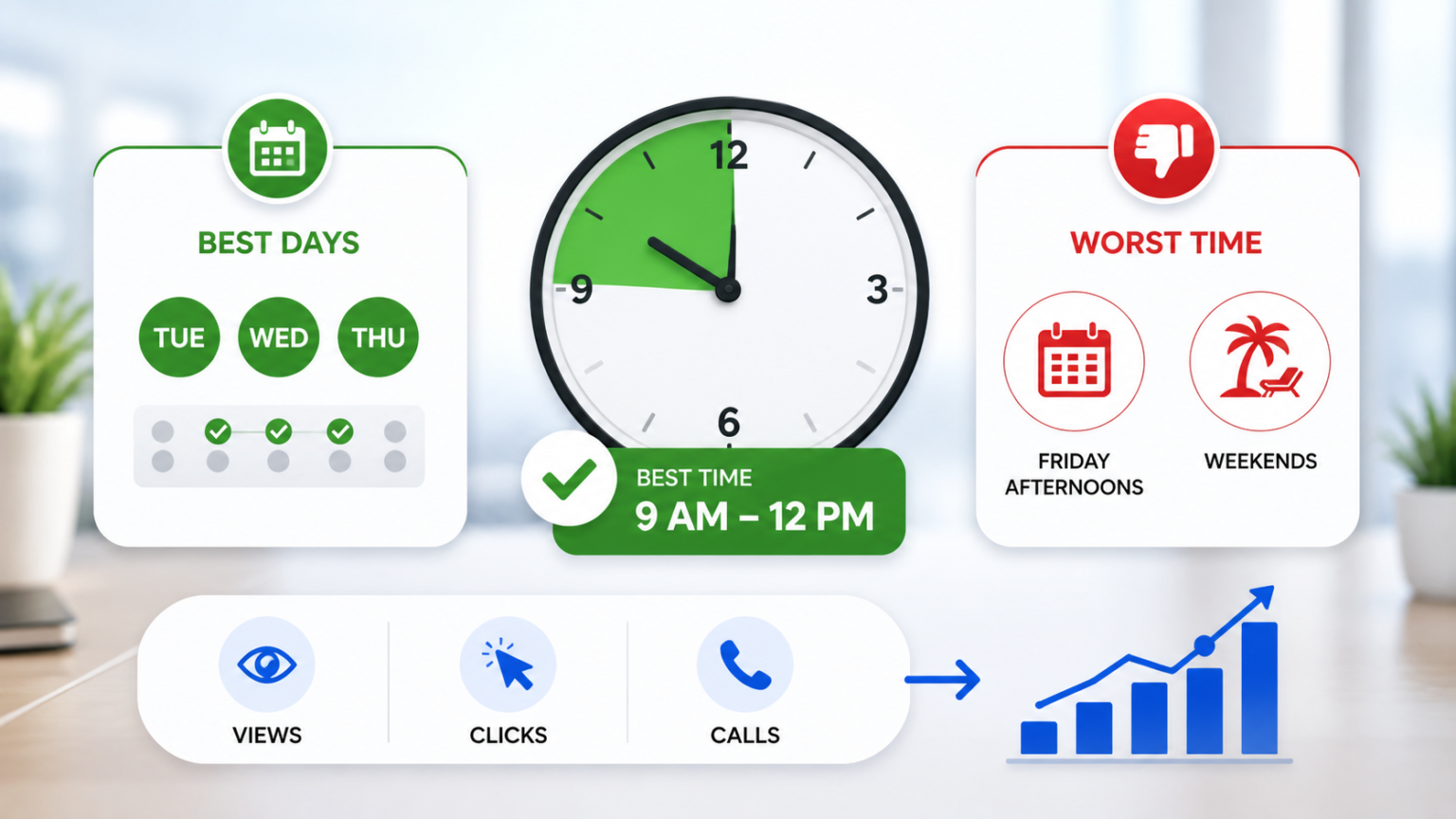
Google doesn’t publish official guidance on optimal posting times, but industry data and testing point to a consistent pattern:
- Best days: Tuesday, Wednesday, and Thursday outperform weekends for most businesses
- Best window: Mid-morning to early afternoon, roughly 9 AM to 12 PM, aligns with the peak period when people are actively searching and making decisions
- Worst time to post: Friday afternoons and weekends tend to see lower engagement for service-based businesses (though restaurants and retail are exceptions)
That said, no universal answer replaces your own data. Use the GBP Insights dashboard to review which posts generate the most profile views, clicks, and call actions, then adjust your schedule to match your specific audience’s behavior.
What to Write: Keyword Strategy Inside GBP Posts
This is the tactic that every competitor article misses entirely, and it’s one of the most actionable things you can do.
Every post you publish is an opportunity to embed locally relevant keywords naturally into your profile content. When Google reads your post text, it reinforces your topical relevance for those terms in local search.
Practical approach:
- Include your core service and location naturally: “Our team is now offering emergency boiler repairs across [City Name]…”
- Match the language your customers actually use when searching: “Looking for a reliable towing service near the I-65 corridor? Here’s what we’re offering this week…”
- Avoid keyword stuffing: Google penalizes posts that read like lists of keywords rather than genuine updates
This isn’t about cramming keywords in. It’s about writing naturally useful posts that happen to reinforce the search terms you want to rank for.
The 100-Character Rule: Front-Load Every Post
GBP posts support up to 1,500 characters of text. But here’s the critical detail no competitor mentions: only the first 100 characters appear in the preview snippet that Google displays on the search results page before a user clicks to expand.
That means the opening line of every post functions like a headline. If your most important information, the offer, the service, the hook, is buried in paragraph two, most people will never see it.
Lead with the value. Every time.
Wrong: “We’ve been in business for 15 years and pride ourselves on great service. This week we’re offering 20% off…”
Right: “20% off all boiler services this week only — book before Friday to claim your discount.”
You may also read: Google Business Profile Optimization for Towing Companies
Common GBP Posting Mistakes to Avoid
Mistake | Why It Hurts |
Skipping the CTA button | Every post should direct users to call, book, or visit, no CTA = wasted conversion opportunity |
Repeating the same post weekly | Google and customers both notice. Variety signals an active, engaged business |
Posting expired promotions | Damages trust and wastes profile real estate on irrelevant content |
Using only stock photos | Authentic images of your team, premises, or work outperform generic stock imagery |
Going 30+ days without posting | Risk dropping out of the Local 3-Pack entirely |
Keyword stuffing post copy | Posts that read unnaturally can be flagged; always write for the customer first |
Ignoring image dimensions | Optimal size is 720×540px (JPG or PNG); images that don’t fit the crop ratio appear distorted in search results |
GBP Performance Metrics You Should Be Tracking
Posting consistently is only half the job. The other half is measuring what’s working. Inside your GBP dashboard under Performance (formerly Insights), track:
- Profile views is your posting activity increasing how often your profile appears?
- Post clicks which post types and topics generate the most engagement?
- Call clicks are people calling directly from your profile?
- Direction requests are posts driving foot traffic intent?
- Photo views are your post images attracting attention in Maps?
Add UTM parameters to any links inside your posts so Google Analytics can show you exactly how much website traffic, and how many conversions, are originating from your GBP content.
Frequently Asked Questions
Yes, indirectly but meaningfully. Regular posting strengthens the prominence factor in Google's local ranking algorithm, signals activity to Google's crawlers, and increases the profile engagement metrics (views, clicks, calls) that correlate with higher local rankings. It won't replace citation building or reviews, but it is a consistent, free lever that compounds over time.
Standard posts expire from prominent display after seven days and are archived after six months. A month-long gap won't immediately tank your rankings, but it will make your Updates section look empty, which can reduce trust with potential customers. More importantly, competitors who post consistently will gradually gain the engagement signals that push them ahead in the Local 3-Pack.
Google's native interface doesn't offer post scheduling; you publish manually through Google Business Manager. Third-party social media management tools can schedule GBP posts alongside other platforms, which is particularly useful for multi-location businesses or agencies managing multiple profiles.
Posts support up to 1,500 characters, but shorter posts often perform better. Aim for 100–300 characters for impact. The single most important rule is to front-load your key message in the first 100 characters, as that's what appears as the preview snippet in search results before a user expands the post.
Not quite. GBP posts appear in Google Search and Maps. They're seen by people who are actively searching for your business or businesses like it, making the audience intent dramatically higher than a typical social media post. The content style should be more direct, more action-oriented, and always tied to something a customer can act on immediately.
Conclusion
Posting on your Google Business Profile isn’t a social media afterthought; it’s a direct line to high-intent customers at the exact moment they’re deciding which business to call, visit, or buy from.
The formula is simple: post at least once a week, use all four post types in rotation, front-load your key message in the first 100 characters, embed locally relevant keywords naturally, and track your performance metrics so you can improve over time.
Consistency is what separates the businesses in the Local 3-Pack from the ones that never make it there. The businesses showing up at the top of local search results aren’t there by accident; they’ve made showing up a habit, week after week, without gaps. So, start this week, and keep going.