





[eac_elementor_tmpl id=”2717″]
Blog
10 SEO Tips for Towing Companies to Dominate Local Search
May 8, 2026
admin
97% of consumers search online to find local businesses, and for towing companies, that number might as well be 100. When a driver is stranded on the side of the road, they aren’t flipping through a phonebook or asking a friend. They’re on Google within seconds, and the data is unambiguous: the #1 result on Google captures 32% of all clicks, while businesses outside the top three receive a fraction of that attention. For towing, where every call is a revenue opportunity, that visibility gap translates directly into dollars lost or gained.
The U.S. towing industry generates over $11 billion in annual revenue, yet the majority of independent operators still rely on word-of-mouth and paid ads, both of which are expensive, inconsistent, and impossible to scale. SEO changes that equation entirely. According to Bright Local, 78% of local mobile searches result in an offline purchase or phone call, making local search optimization the highest-ROI marketing channel available to a towing business.
But ranking in 2026 requires more than just a Google Business Profile and a few keywords. Algorithm updates, Core Web Vitals, E-E-A-T signals, schema markup, and AI-driven search results have raised the bar significantly. This guide breaks down 10 data-backed SEO tips for towing companies, built from a deep analysis of what top-ranking competitors do well, so you can keep your dispatch line busy.
An All-Inclusive List of SEO Strategies for Towing Companies
Tip 1: Claim and Fully Optimize Your Google Business Profile
Your Google Business Profile (GBP) is the single most powerful local SEO asset you own, and it’s free. When someone searches “towing company near me,” Google shows a local Map Pack of three businesses before any organic results. Getting into that Map Pack starts with a fully optimized GBP.
What to do:
- Select the most accurate primary category (e.g., Towing Service)
- Fill in your complete service area, business hours, and a keyword-rich business description
- Upload high-quality photos of your trucks and team
- Enable the call and booking buttons
- Use the Q&A section to pre-answer common questions like pricing and response time
- Post regular GBP updates — Google rewards active profiles
Pro tip: Keep your Name, Address, and Phone number (NAP) identical across your GBP, website, and every other online listing. Even a small inconsistency, “St.” vs. “Street,” can hurt your local rankings.
Tip 2: Build a Rock-Solid Keyword Strategy
Every piece of SEO effort needs a keyword foundation. For towing companies, the most valuable keywords fall into two buckets:
|
Keyword Type |
Examples |
|
Emergency / High-intent |
“tow truck near me,” “24-hour towing [city],” “emergency towing service” |
|
Service-specific |
“flatbed towing,” “heavy-duty towing,” “long-distance towing,” “accident recovery” |
|
Informational |
“how much does towing cost,” “what to do when your car breaks down,” “roadside safety tips” |
|
Local modifiers |
“towing company in [neighborhood],” “tow truck [freeway/landmark]” |
Use tools like Google Keyword Planner, Semrush, or Keyword Surfer to find search volume data. Target a mix of high-volume terms and lower-competition long-tail keywords; they convert better because the searcher’s intent is crystal clear.
Tip 3: Create Dedicated Service and Location Pages
One of the biggest missed opportunities for towing companies is relying on a single homepage to rank for every service and every city they cover. That approach almost never works.
Instead, build individual landing pages for each:
- Service type: flatbed towing, motorcycle towing, heavy-duty recovery, winch-out service, roadside assistance, jump starts, lockouts
- Location: every city, town, or neighborhood in your service area
Each page should include the target keyword in the title tag, H1, first paragraph, and meta description. Include a Google Map embed, your local phone number, and customer reviews specific to that area. These pages become targeted entry points for the exact searches your customers are making.
Tip 4: Optimize Your Technical SEO Foundation
Fast, crawlable websites rank higher. Technical SEO ensures Google can find, understand, and trust your site. Key areas to audit:
|
Technical Factor |
Why It Matters |
Target |
|
Core Web Vitals (LCP) |
Measures loading speed |
Under 2.5 seconds |
|
Core Web Vitals (CLS) |
Measures visual stability |
Score below 0.1 |
|
Mobile responsiveness |
80%+ of towing searches happen on mobile |
Fully responsive |
|
HTTPS / SSL |
Google penalizes unsecured sites |
Must be active |
|
XML Sitemap |
Helps Google crawl all your pages |
Submitted to Search Console |
|
Crawlability |
Ensures no pages are accidentally blocked |
Check robots.txt |
Use Google Search Console to identify crawl errors, and Page Speed Insights to measure your Core Web Vitals scores. A site that loads in under 2.5 seconds on mobile is not optional in a field where every second matters.
Tip 5: Add Schema Markup (Structured Data)
This is one of the most overlooked SEO advantages available to towing companies, and your competitors almost certainly aren’t using it.
Schema markup is a code snippet you add to your website that tells Google exactly what your business is and what it offers. For towing companies, the most important schema types are:
- Local Business schema: Communicates your name, address, phone, hours, and service area directly to Google
- Service schema: Describes each towing service you offer
- FAQ schema: Makes your FAQ answers eligible to appear directly in search results
- Review schema: Displays your star rating in the search snippet
Schema markup increases your chances of appearing in rich results, Google AI Overviews, and featured snippets, all of which dramatically increase click-through rates without requiring a higher ranking.
Tip 6: Build Your E-E-A-T Signals
Google evaluates content using a quality framework called E-E-A-T: Experience, Expertise, Authoritativeness, and Trustworthiness. For a towing company, an emergency service that people rely on in stressful moments, these signals are especially important.
How to build E-E-A-T for your towing website:
- Add an About Us page with real team bios, years of experience, and certifications
- Display your business license, insurance information, and any industry affiliations (AAA approval, Wreck Master certification, etc.)
- Showcase before/after photos and video testimonials from real customers
- Earn mentions from local news outlets, community organizations, or auto industry publications
- Maintain a clean BBB profile or equivalent trust badge
Tip 7: Earn High-Quality Backlinks from Local Sources
Backlinks are votes of confidence from other websites. The more reputable the source, the more authority it transfers to your site. For towing companies, the most valuable backlinks come from:
- Local auto repair shops and dealerships — mutual referral partnerships
- Insurance companies and roadside assistance providers — preferred vendor listings
- Local news websites — coverage of emergency responses, community sponsorships, or weather events
- City business directories and local chambers of commerce
- Guest posts on auto-related blogs or safety websites
Avoid low-quality link farms. One backlink from a trusted local newspaper is worth dozens from generic directories.
Tip 8: Generate and Manage Online Reviews Strategically
Reviews are a direct local ranking factor, and for towing companies, they’re also the primary trust signal a stranded driver uses to choose who to call.
A review generation system that works:
- After every completed job, send an automated SMS with a direct Google review link
- Place a QR code on the back of your trucks that links to your Google review page
- Train drivers to ask for a review verbally at the end of positive interactions
- Respond to every review, positive and negative, using keywords like your city name and service type
When responding to reviews, phrases like “Thank you for trusting [Company Name] for emergency towing in [City]” naturally embed local keywords that boost your local ranking signals.
Tip 9: List Your Business on Every Relevant Platform
Google is where most towing leads come from, but it’s not the only platform that matters. Consistent, accurate listings across multiple directories strengthen your citation profile, a key local SEO ranking signal.
Platforms every towing company should be listed on:
|
Platform |
Why It Matters |
|
Google Business Profile |
Primary local ranking factor |
|
Bing Places for Business |
Captures Bing + Cortana searches |
|
Apple Maps |
Default map for all iPhone users |
|
Yelp |
High-authority review platform |
|
AAA Approved Auto Repair (if eligible) |
Industry-specific trust signal |
|
Local chamber of commerce |
Local authority backlink |
|
Roadside assistance apps |
Direct lead source |
Ensure your NAP information is letter-for-letter identical on every single listing.
Tip 10: Track Performance and Refine Continuously
SEO is not a one-time task; it’s an ongoing process. Without tracking, you’re driving blind. Essential tools and metrics to monitor:
- Google Analytics 4: Track organic traffic, user behavior, and conversion events
- Google Search Console: Monitor keyword rankings, impressions, clicks, and crawl errors
- Call tracking software (e.g., Call Rail): Since most towing leads are phone calls, tracking which keywords drive calls is critical to measuring real SEO ROI
- Semrush or Ahrefs: Monitor your backlink profile and keyword position changes
Set a monthly review cadence. If a service page isn’t ranking after 90 days, revisit the keyword targeting, add more content, or build more links to that page.
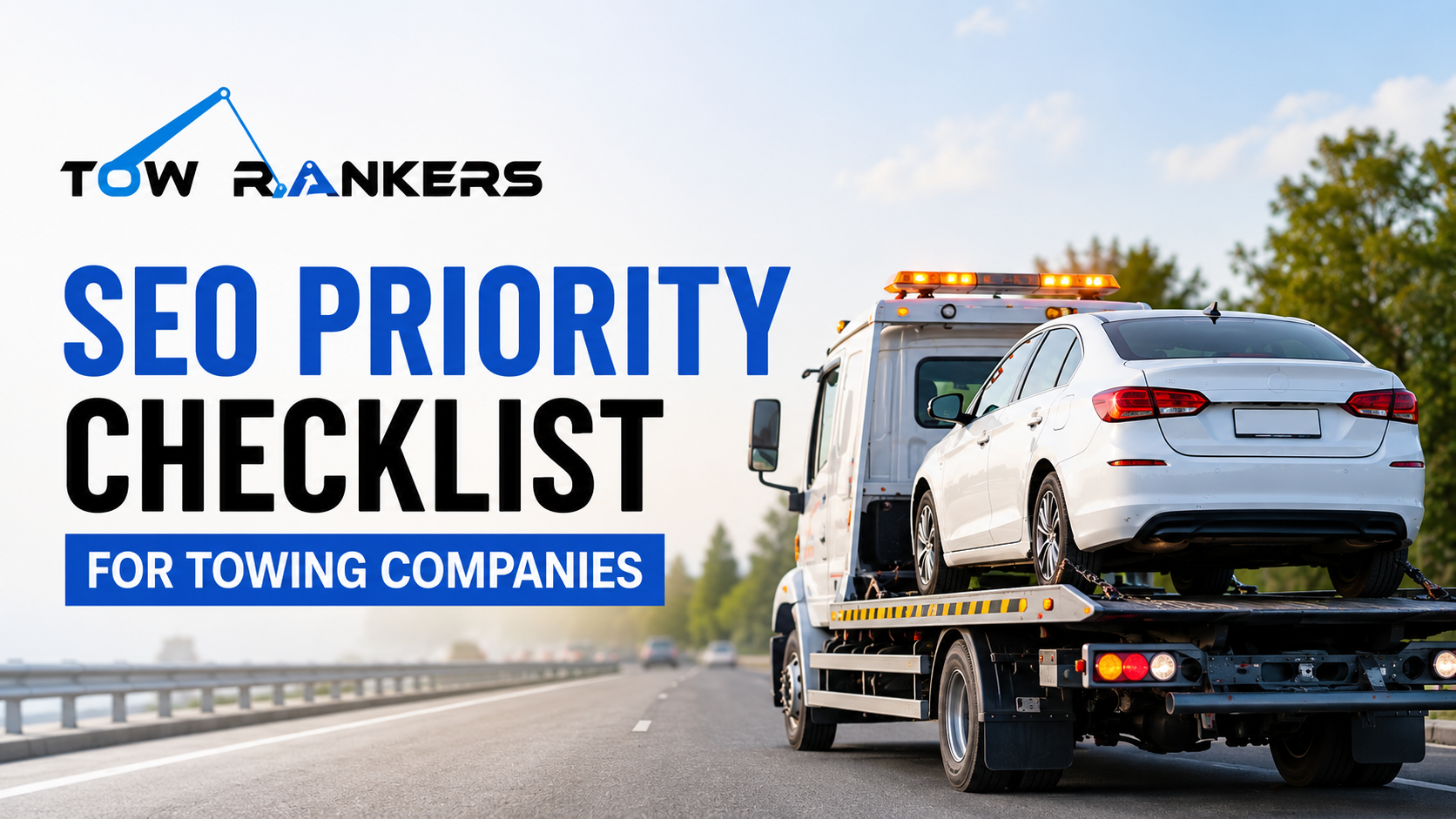
Quick-Reference: SEO Priority Checklist for Towing Companies
|
Priority |
Action Item |
Impact |
|
High |
Optimize Google Business Profile |
Local Map Pack visibility |
|
High |
Create service + location pages |
Rank for specific searches |
|
High |
Fix Core Web Vitals on mobile |
Technical ranking factor |
|
Medium |
Add Local Business + FAQ schema |
Rich results & AI visibility |
|
Medium |
Build review generation system |
Local ranking + trust signals |
|
Medium |
Earn local backlinks |
Domain authority growth |
|
Ongoing |
Update GBP posts & content |
Freshness signals |
|
Ongoing |
Monitor analytics & call tracking |
ROI measurement |
Explore more: SEO Services for Towing Companies
Frequently Asked Questions
How long does SEO take for a towing company?
Most towing companies begin seeing measurable improvements in local rankings within 3 to 6 months of consistent SEO work. Emergency “near me” searches tied to Google Maps can show results faster, often within 4 to 8 weeks, once your Google Business Profile is fully optimized and accumulating reviews.
What is the most important SEO tip for a towing company?
Optimizing your Google Business Profile is the highest-impact single action you can take. It directly influences your placement in the Google Maps Pack, which drives the majority of emergency towing calls
Do towing companies need a website, or is a GBP enough?
Both are essential. Your GBP drives Map Pack visibility, but a well-structured website with service pages, location pages, and schema markup is what enables you to rank in organic search results and capture a broader range of search queries.
What keywords should towing companies target?
Start with high-intent local keywords like “towing company [your city],” “24-hour tow truck near me,” and service-specific terms like “flatbed towing” or “accident recovery.” Combine these with informational keywords to build topical authority over time.
Is paid advertising (PPC) better than SEO for towing companies?
They serve different purposes. PPC provides instant visibility but costs money for every click. SEO builds sustainable, long-term lead generation that grows more cost-efficient over time. For towing companies, Google Local Services Ads (LSA), a pay-per-lead format, pairs exceptionally well with organic SEO as a combined strategy.
Conclusion
Winning the local search game as a towing company comes down to one principle: be present, trustworthy, and fast exactly when someone needs you. That means showing up in the Google Maps Pack, ranking for emergency and service-specific keywords, loading your website in under three seconds on a cracked iPhone screen, and having hundreds of verified reviews that build instant confidence.
The 10 SEO tips in this guide, from Google Business Profile optimization and schema markup to E-E-A-T signals and call tracking, give you a complete roadmap. You don’t need to implement everything at once. Start with your GBP, build out your service and location pages, and add structured data. From there, layer in reviews, backlinks, and analytics.
The towing companies that invest in SEO today are the ones whose phones will ring tomorrow and for years to come.