Blog
SEO for Towing Services and Tow Truck Operators: The Complete Guide
May 7, 2026
admin
When a driver is stranded on the side of the highway at midnight, they do one thing: reach for their phone. They search ‘tow truck near me’ or ’emergency towing service’ and call the first result they trust. If your towing company is not in those first few results, that job, and every job like it, goes to a competitor.
Search engine optimization (SEO) for towing services is the strategy that puts you at the top of those results. Unlike traditional advertising, such as billboards or flyers, SEO works 24/7. Your optimized website becomes your most reliable dispatcher, generating qualified calls even while your trucks are already on the road.
This guide covers every proven tactic, from Google Business Profile optimization and local citation building to technical SEO, schema markup, content strategy, and AI-powered automation, so you can dominate local search in your service area and grow your towing business sustainably.
Why SEO Matters for Towing Companies?
The global vehicle roadside assistance market was valued at USD 28.7 billion in 2025 and is projected to reach USD 44.1 billion by 2035. That growth is driven largely by mobile search. Nearly every towing-related search happens on a smartphone, and users searching for roadside help carry high-intent, urgent purchase intent; they are not browsing, they are ready to call.
Most towing searches share distinct characteristics that make SEO uniquely valuable for this industry:
- Urgency: Customers need help immediately. Speed of discovery matters above all else.
- Hyperlocal intent: Searches like ‘tow truck near me,’ ‘car lockout service downtown,’ or ‘roadside assistance I-95 exit 42’ are hyperlocal by nature.
- Voice search: Drivers with a flat tire are just as likely to say ‘Hey Siri, find a tow truck’ as they are to type. Voice search optimization is non-negotiable.
- Mobile-first behavior: Google indexes mobile versions of sites first. A slow or non-responsive towing website loses rankings and customers simultaneously.
Organic SEO also delivers results that paid advertising cannot sustain alone. A well-optimized towing website generates inbound leads continuously, without per-click costs, building a compounding return over time.
Local SEO: The Foundation for Towing Companies
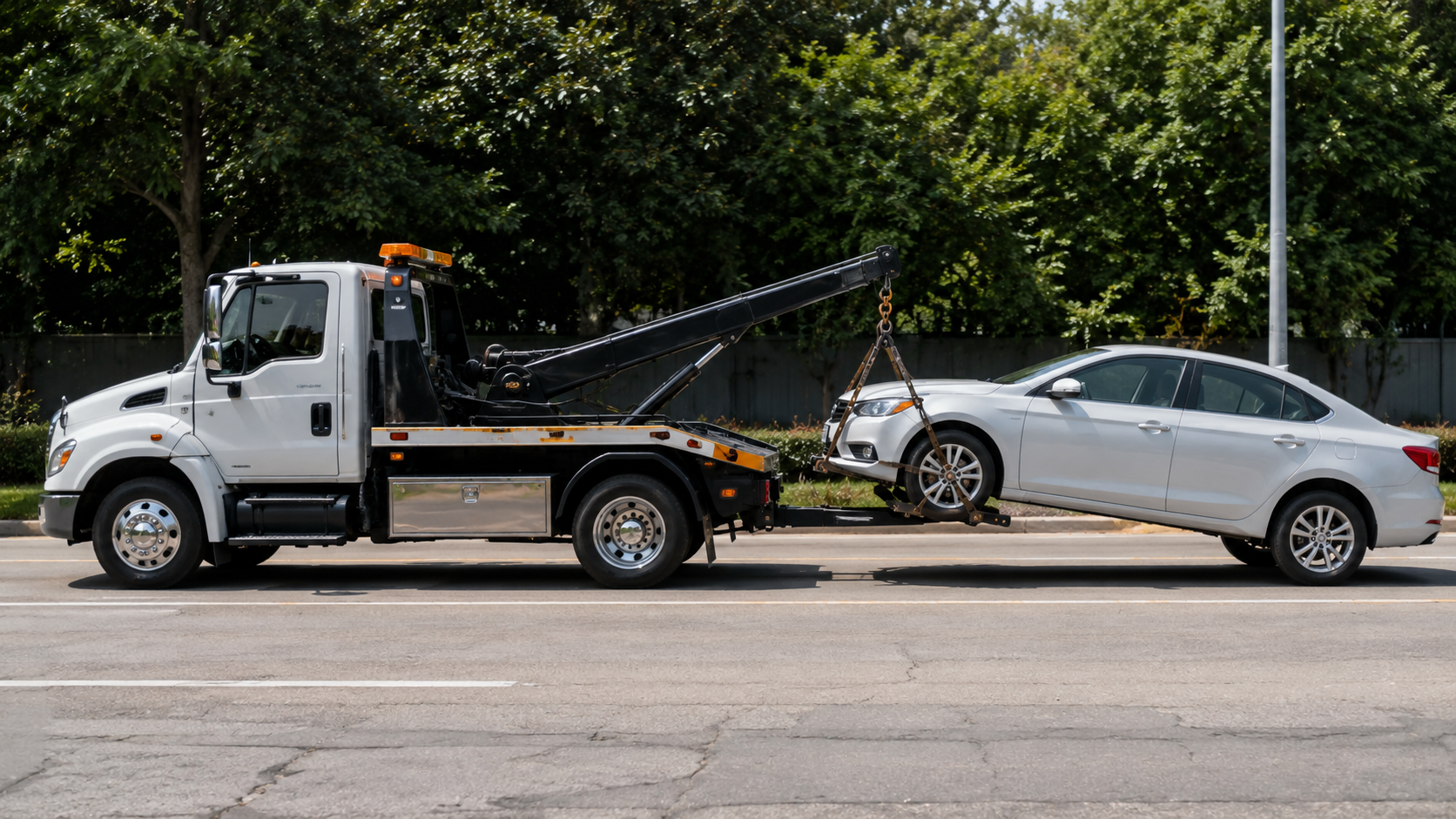
Local SEO is the practice of optimizing your online presence so your towing business appears in searches performed near your service area. For towing operators, this means ranking in the Google Map Pack, the three business listings displayed above organic results for local queries. Appearing in the Map Pack alone can double your call volume.
Optimize Your Google Business Profile
Your Google Business Profile (GBP) is the single most important local SEO asset you own. It powers your appearance in the Map Pack, Google Maps, and local search results. An incomplete or unoptimized GBP profile is the number one reason towing companies lose local rankings.
- Set ‘Towing Service’ as your primary category. Add secondary categories such as Roadside Assistance, Car Lockout Service, and Tire Repair Service.
- Ensure your Name, Address, and Phone (NAP) information is exactly consistent with every other listing online. Even minor discrepancies weaken your local authority.
- Add photos of your tow trucks, equipment, and team. Profiles with high-quality images receive significantly more engagement and calls.
- Publish regular GBP posts, service updates, seasonal offers, and emergency announcements, to signal to Google that your profile is actively managed.
- Use the GBP Q&A feature to pre-answer common driver questions, which also adds keyword-rich content to your profile.
It is equally important to claim and optimize your listings on Bing Places, Apple Maps, and Waze. Many drivers, particularly iPhone users, rely on Apple Maps for navigation. Ignoring these platforms leaves a meaningful portion of potential calls unaddressed.
Build and Manage Local Citations
A local citation is any online mention of your towing business’s name, address, and phone number. Citations on trusted directories, Yelp, Yellow Pages, BBB, Angi, and industry-specific platforms like AAA partner directories and insurance company referral networks signal to Google that your business is legitimate and locally relevant.
NAP consistency across all citations is critical. Google cross-references your listings. Conflicting information creates confusion for search algorithms and can suppress your Map Pack rankings.
Keyword Research and Strategy for Towing SEO
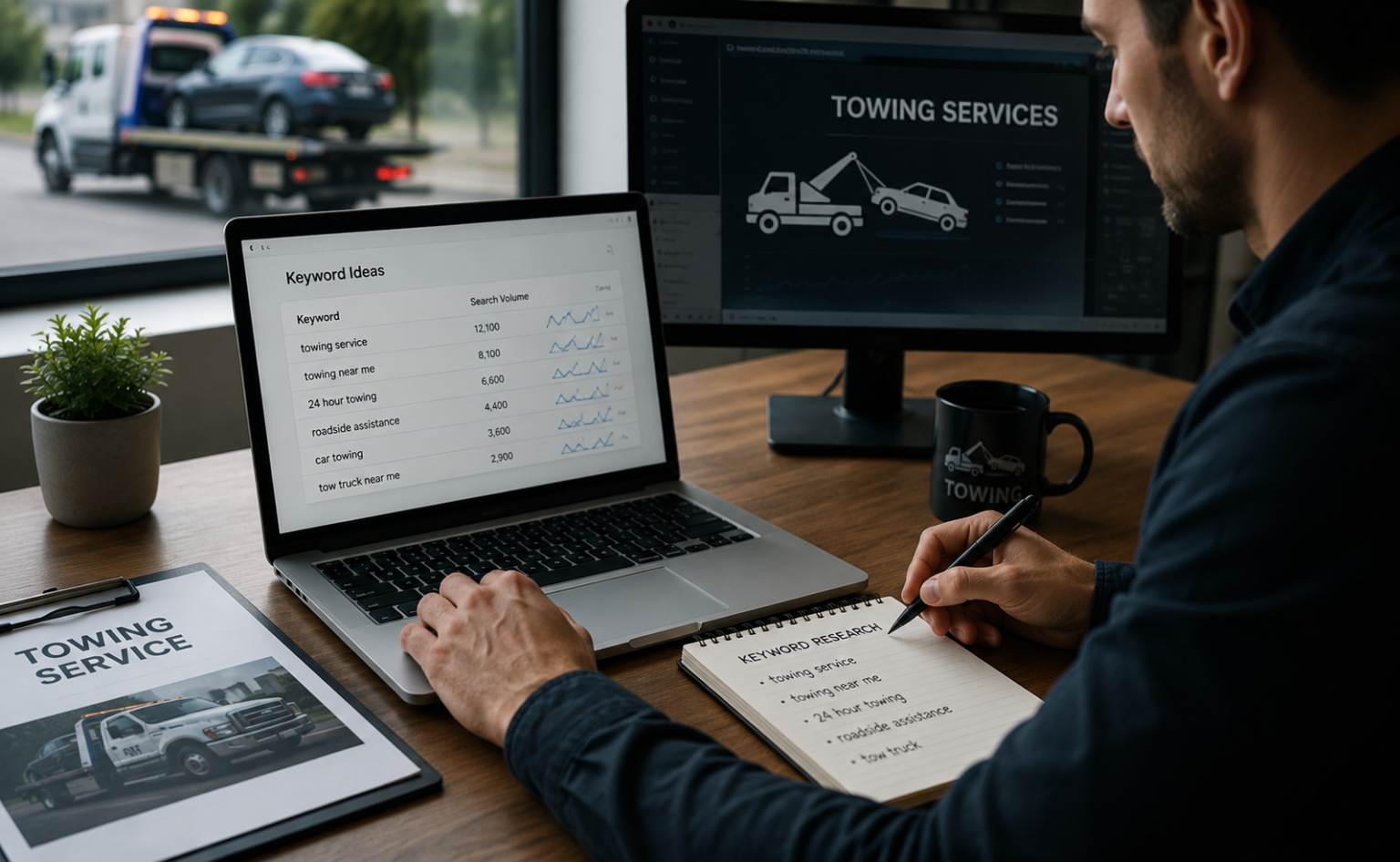
Effective keyword research for towing SEO starts with understanding search intent. The majority of towing-related searches fall into urgent, transactional intent; users want help now, not later. Your keyword strategy should reflect this.
Keyword Type | Example Keywords | SEO Priority |
Emergency/Urgent | tow truck near me, emergency towing 24/7 | Highest |
Service-specific | flatbed towing, vehicle recovery service | High |
Location-based | towing service [city], tow truck [zip code] | High |
Roadside assistance | jump start service, flat tire help near me | Medium-High |
Voice search | who tows cars near me, get my car towed now | Growing |
Build dedicated service area pages for each city, county, or corridor you serve. A page titled ‘Towing Service in [City Name]’ with locally relevant content, driving directions, and service details outperforms a generic ‘We serve all of [State]’ statement every time.
Also target long-tail keyword variants such as ‘affordable tow truck open now’ or ’24-hour roadside assistance near highway.’ These phrases carry lower competition and extremely high conversion intent.
On-Page SEO for Towing Websites
On-page SEO ensures every page on your towing website sends clear, accurate signals to search engines about what you do and where you do it.
- Title tags: Include your primary keyword and city name. Example: ‘Emergency Towing Service in Phoenix, AZ | Fast 24/7 Help’
- Meta descriptions: Write a compelling 150–160 character summary that highlights speed, availability, and service area. Meta descriptions do not directly affect rankings but significantly impact click-through rates.
- Header tags (H1–H3): Each service page should have a single H1 containing your target keyword. Use H2 and H3 subheadings to organize content and incorporate secondary keywords naturally.
- URL structure: Keep URLs short and descriptive. Use /towing-service-phoenix/ rather than /services/page?id=14.
- Alt text: Every image of your tow trucks and operations should have descriptive alt text that includes relevant keywords and location where appropriate.
- Internal linking: Link between your service pages, location pages, and blog content to establish a logical site hierarchy and distribute page authority.
Technical SEO Essentials for Towing Operators
Technical SEO addresses the backend factors that affect how search engines crawl, index, and rank your website. For towing companies, these are non-negotiable basics:
- Site speed and Core Web Vitals: Google measures Largest Contentful Paint (LCP), Cumulative Layout Shift (CLS), and Interaction to Next Paint (INP). Slow-loading towing websites lose both rankings and customers who abandon before the page loads.
- Mobile-first responsive design: Your entire site must perform flawlessly on smartphones. Google’s mobile-first indexing means your mobile site is evaluated first.
- SSL certificate (HTTPS): An unsecured website is penalized in rankings and displays a ‘Not Secure’ warning that deters callers.
- XML sitemap: Submit a clean sitemap to Google Search Console so all your service and location pages are discovered and indexed.
- Schema markup: Implement Local Business schema and Service schema on your pages. Schema provides structured data that helps search engines understand your business type, service area, hours, and phone number, increasing your eligibility for rich results.
- Minify CSS/JS and defer non-essential scripts: This directly improves page load times, which affects both rankings and conversion rates.
Google Local Service Ads and the Google Guaranteed Badge
Beyond organic SEO, Google Local Service Ads (LSA) offer towing companies a powerful complement to their organic strategy. Unlike standard pay-per-click ads, LSAs charge per qualified lead rather than per click, making the cost model more predictable for towing businesses.
Achieving the Google Guaranteed badge through LSA verification signals to drivers that your towing company has passed Google’s background and license checks. This trust marker appears directly in search results and measurably increases call volume. Pairing Performance Max campaigns with organic SEO and LSA creates a comprehensive visibility stack that captures demand at every stage of the search results page.
Online Reputation Management for Towing Companies
Google reviews are a direct local ranking factor. The volume and sentiment of your reviews influence where you appear in the Map Pack. Beyond rankings, reviews are the first thing a stranded driver reads before deciding to call.
- Respond professionally to every review, positive and negative. Public responses demonstrate customer service quality to prospective callers.
- Encourage satisfied customers to leave Google reviews through follow-up texts or automated review request messages after job completion.
- Monitor and manage your reputation across Facebook, Instagram, Google Business, and Yelp to maintain consistent brand trust across all platforms.
A towing company with 4.7 stars and 200 reviews will consistently outperform a competitor with 4.9 stars and 8 reviews. Sustained review volume signals ongoing business activity to Google’s local ranking algorithm.
Link Building and Authority for Towing SEO
Backlinks, links from other websites pointing to yours, remain one of Google’s strongest ranking signals. For towing companies, the most valuable backlinks come from:
- Local automotive websites, car dealerships, and repair shops
- Local news sites and community directories
- AAA, roadside assistance networks, and insurance partner directories
- Industry associations and towing trade organizations
- Digital PR: publishing data-driven content such as local traffic statistics or seasonal road safety guides that earns media coverage and natural backlinks
Quality consistently outweighs quantity. A single link from a trusted local news site carries more ranking weight than fifty links from low-authority directories. Regularly audit your backlink profile to identify and disavow harmful links.
Content Strategy and Topical Authority
Google rewards websites that demonstrate topical authority, deep, organized coverage of a subject area. For towing companies, building topical authority means creating content clusters around core service topics.
A strong towing content strategy includes dedicated pages or blog posts covering topics such as: what to do when your car breaks down, how to choose a reliable towing company, the difference between flatbed and hook-and-chain towing, and seasonal preparedness guides for winter driving. This content targets informational search intent and attracts drivers who are not yet in an emergency but will be future customers.
Content also amplifies every other SEO tactic. More indexed pages mean more keyword coverage, more internal linking opportunities, and more assets that can earn backlinks
Common SEO Mistakes in Towing Industry
Avoid these pitfalls:
- Ignoring Google Business Profile
- Targeting broad keywords only
- Slow, outdated websites
- No location pages
- Poor mobile experience
- Lack of reviews
These issues significantly reduce visibility and lead flow.
How Tow Rankers Helps Towing Companies Execute All of This
Understanding SEO strategy is one thing. Executing it consistently while running a towing operation, managing dispatch, maintaining trucks, and responding to emergencies around the clock is another challenge entirely. This is where Tow Rankers was built to help.
Tow Rankers is an AI-powered growth platform built exclusively for towing and roadside assistance businesses. It automates and accelerates the work that takes most operators weeks to set up and months to maintain.
Frequently Asked Questions
Most towing companies begin seeing improvements in local Map Pack rankings within 60 to 90 days of consistent optimization. Full competitive organic rankings typically develop over 4 to 6 months, depending on your market's competition level and the authority of your existing website.
Optimizing your Google Business Profile is the single highest-impact action for most towing operators. A complete, verified, photo-rich GBP with consistent NAP information and active review management directly determines your Map Pack visibility, which is where the majority of emergency towing calls originate.
Yes. LSA and organic SEO are complementary, not competing strategies. LSA captures urgent demand at the very top of search results while organic SEO builds long-term authority. Together, they maximize your coverage across the full search results page.
Yes. A website improves credibility, rankings, and conversion rates.
Optimize for local SEO, maintain consistent NAP data, gather reviews, and create location-based pages.
Implement the Local Business schema and Service schema as a minimum. These tell Google your business type, service area, operating hours, and phone number in a structured format, which can enable rich results and improve click-through rates from search listings.
Extremely important. Google's local ranking algorithm weighs review signals heavily, including the volume, recency, and average star rating of your reviews. Beyond rankings, reviews are the primary trust signal that converts a searcher into a caller when they are comparing towing companies in distress.
Yes. Dedicated service area pages for each city, neighborhood, or highway corridor you serve allow you to rank for hyperlocal search terms specific to each location. A single generic page claiming broad coverage cannot compete with city-specific pages that contain locally relevant content, directions, and keywords.
AI can automate lead capture, improve response times, and optimize targeting, resulting in higher conversions.
Conclusion
SEO for towing services is not a one-time task; it is an ongoing system that compounds over time. From optimizing your Google Business Profile and building consistent local citations to implementing schema markup, earning quality backlinks, managing your online reputation, and targeting the right hyperlocal keywords, every component works together to make your towing company the first result a stranded driver finds.
The towing industry is growing fast, and the operators who invest in their digital presence now will be the ones dominating local search results in their markets for years to come. Start with the fundamentals, build your content and authority steadily, and let AI-powered tools like Tow Rankers handle the automation so you can stay focused on what matters most, getting to your customers faster than anyone else.