Blog
Why Your Towing Company Needs a Website in 2026?
May 5, 2026
admin
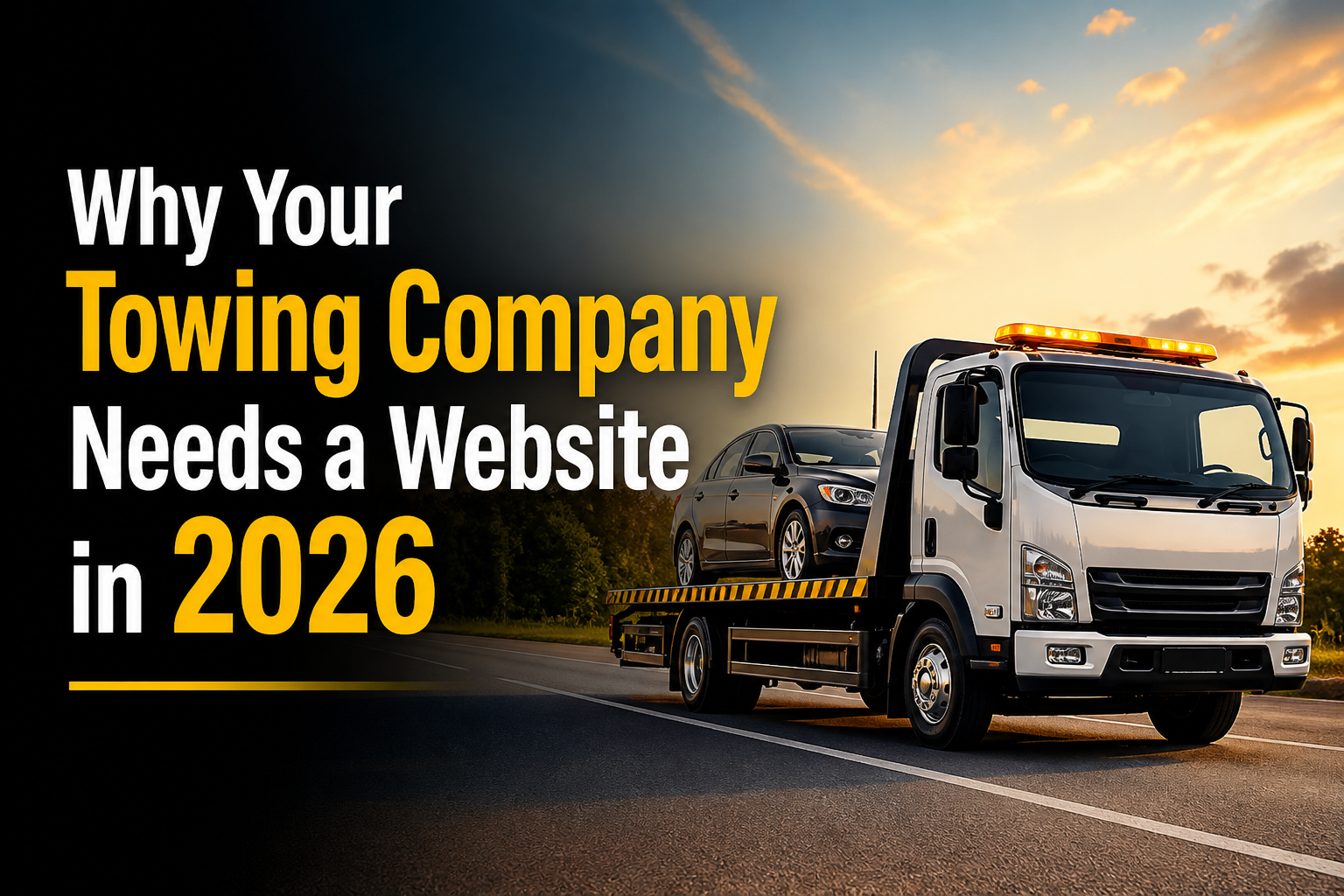
Picture this: it’s 2 a.m. on a Wednesday. A driver’s car just died on the highway. They’re stressed, it’s dark, and they pull out their phone and search “tow truck near me.” Your company shows up. They tap your link. The page takes eight seconds to load, the phone number is buried at the bottom, and the site looks like it hasn’t been touched since 2014.
They hit back and call your competitor. That job is gone. You never even knew it existed.
This is happening every single night across your service area, and if your towing company doesn’t have a strong, professional website, you’re handing revenue to the competition while you sleep. In this guide, we’ll break down exactly why your towing business needs a website, what it must include, and how to turn it into a 24/7 lead machine.
The Real Cost of Not Having a Website
Let’s talk numbers before anything else. The average emergency tow job generates between $75 and $250 in revenue. If your lack of online presence causes you to miss just one call per night, that’s a potential loss of $27,000—$91,000 per year in missed revenue, from a single gap in your digital strategy.
Around 30% of all business activity now happens online. For towing specifically, the figure is even more striking: roughly 90% of towing searches happen on mobile phones, and most of them occur outside normal business hours. Without a website, you don’t exist for those customers.
A social media page alone isn’t enough. Scam profiles and duplicate listings have made customers deeply skeptical of Facebook pages without a corresponding website. A professional site is the difference between a legitimate business and one they’ll scroll past.
5 Powerful Reasons Your Towing Company Needs a Website

1. You Become Visible When Customers Need You Most
Every towing customer is having a bad day. Nobody plans to need to a tow. That means every search is an emergency search, and emergency searchers don’t browse five websites. They call the first credible result they find.
A website optimized for local SEO puts you in front of those searchers at exactly the right moment. When someone types “flatbed towing near me” or “emergency towing in [your city],” a well-built site, complete with location-based content, city-specific service pages, and Google Maps integrations, tells Google you’re the most relevant answer.
Without a website, your Google Business Profile can only do so much. The two work together: your GBP drives discovery, your website drives conversion.
2. It Builds Instant Trust and Credibility
In an emergency, customers make snap decisions. A towing company with a professional website, displayed star ratings, and genuine Google reviews wins the call over a competitor with none of those signals every single time.
Your website is where trust is built. Key credibility elements include:
Trust Signal | Why It Matters |
Customer reviews & star ratings | 88% of consumers trust online reviews as much as personal recommendations |
SSL certificate (HTTPS) | Shows the site is secure; Google uses it as a ranking signal |
Insurance & USDOT number | Confirms legitimacy to both individual customers and fleet managers |
Professional team bios & About Us page | Humanizes the business and communicates values |
Fleet showcase with truck photos & specs | Confirms you have the right equipment for the job |
A page displaying your licenses, insurance coverage, and USDOT number doesn’t just reassure nervous customers; it’s the gateway to high-value B2B contracts with insurance companies, fleet operators, and municipal authorities, all of whom require proof of credentials before signing agreements.
3. Your Website Works 24/7 — Even When You’re Asleep
Your towing operation runs around the clock. Your website should too. Unlike a phone that goes to voicemail at midnight, a fast and well-structured website answers every visitor’s questions, displays your emergency contact number prominently, and captures leads, all without any staff involvement.
This is where the practical design of your site becomes critical. A towing website built for real-world use must have:
- A large, tap-to-call phone number at the very top of every page, no scrolling, no hunting
- Page load time under 3 seconds on mobile cellular connections
- Mobile-first design with large buttons, readable fonts, and no disruptive pop-ups
- After-hours call handling, whether a live answering service, automated dispatch system, or AI call responder that captures location and sends alerts
- An online quote or booking form for non-urgent scheduled tows
Every second of load time costs you customers. A site that takes five seconds to load loses nearly half its visitors. For a towing company, that’s not a statistic, that’s real jobs driving to your competitors.
4. It Dominates Local Search Results
Local SEO is the single most powerful driver of inbound towing leads. A website lets you build out the content infrastructure that makes Google trust you as the top answer for searches in your area.
Effective local SEO for towing companies includes:
- NAP consistency: Your business Name, Address, and Phone number must be identical across your website, Google Business Profile, Yelp, and every other directory listing
- Service-area pages: Dedicated pages for each city, town, and highway corridor you cover (e.g., “Towing Services in [City Name]” or “Emergency Towing on I-65”)
- Schema markup: Structured data code (Local Business, Service, and FAQ Page schema) that helps Google display rich results like star ratings, business hours, and service types directly in search
- Location-specific keywords: Phrases like “tow truck near me,” “24-hour towing [city],” and “flatbed towing [neighborhood]” embedded naturally throughout your content
Schema markup is a critical entity that every one of your competitors overlooks entirely. Implementing it can get your business featured in Google’s rich results, map packs, and AI-powered answer panels, placements most towing companies never reach.
5. It Opens Doors to Google’s Most Valuable Ad Placements
Google Local Services Ads (LSAs) sit above regular paid ads and organic results at the very top of the search page. They display a “Google Guaranteed” badge, your star rating, and a click-to-call button, and you only pay when a verified lead contacts you.
To qualify for LSAs, you need a verified business with a professional online presence. Your website is the foundation that makes that verification possible. Towing companies that combine a strong website with LSAs dominate local search pages on two levels simultaneously: organic results and paid placements.
What Your Towing Website Must Include?
A towing website is not a brochure. It is a lead-generation tool built around the urgent needs of distressed drivers. Here is what every effective towing website needs:
Essential pages:
- Homepage with prominent phone number and service summary
- Individual service pages (emergency towing, flatbed towing, roadside assistance, lockout, fuel delivery)
- Service area page with map and list of cities, towns, and highway corridors covered
- Fleet showcase page with photos and specs of each truck type
- Reviews and testimonials page
- About Us page with team bios, company history, and mission statement
- Insurance, licenses, and credentials page
- FAQ section
- Blog / resource section for ongoing SEO content
Technical must-haves:
- SSL certificate and firewall protection
- Google Analytics and conversion tracking
- Schema markup (Local Business, Service, FAQ Page)
- WCAG-compliant accessibility (alt text, keyboard navigation, readable contrast)
- Integration with dispatch software (e.g., Tow Rankers’ CRM) so web bookings auto-create jobs
You May Also Read: How to Get More Towing Business: Proven Strategies That Work
How Tow Rankers Builds Your Website, and Then Fills It With Leads ?
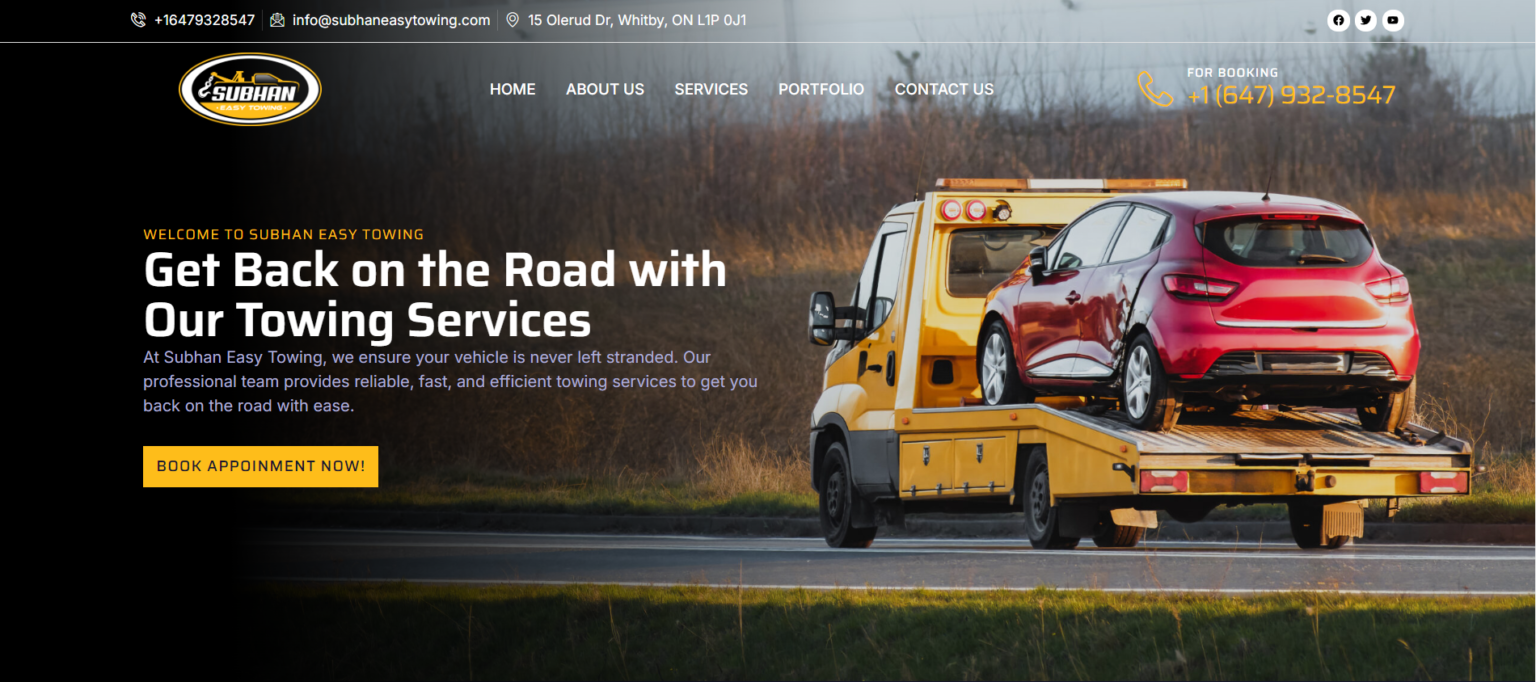
Getting a great towing website is only half the equation. The other half is making sure that website consistently generates verified, high-intent leads, automatically, around the clock. That’s exactly what Tow Rankers is built to do.
Tow Rankers is an AI-powered growth platform built exclusively for the towing and roadside assistance industry. Unlike generic web agencies, every tool, every feature, and every strategy is engineered specifically around how towing businesses operate and how towing customers search.
Here’s what you get when you partner with Tow Rankers:
Tow Rankers Service | What It Does for Your Business |
Website Development | High-converting, mobile-first towing websites built for speed, local SEO, and AI integration |
AI Lead Generation | Scans Google, Maps, and local search 24/7 to capture high-intent towing leads automatically |
AI Dispatch | Routes qualified calls directly to your dispatch line — no manual filtering, no missed jobs |
AI Voice Assistant | Calls customers to confirm ETAs and job details automatically, even at 2 a.m. |
Frequently Asked Questions
Yes, and the two work together rather than replacing each other. Your GBP drives discovery in the Google Map Pack, but it can only show limited information. Your website is where potential customers go to verify your credibility, view your services in detail, and make contact. GBP without a website is like a billboard with no phone number.
A basic, professional towing website typically costs between $500 and $3,000 to build, depending on whether you use a website builder or hire a developer. Ongoing costs for hosting, maintenance, and SEO usually run $50–$300 per month. Given that a single recovered towing contract can be worth tens of thousands of dollars, the ROI is significant.
Most new websites begin seeing measurable organic traffic within 3–6 months, assuming consistent local SEO practices, including regular content updates, citation building, and review generation. Service-specific city pages and schema markup can accelerate this timeline noticeably.
For emergency towing, it's your phone number, large, bold, tap-to-call, and visible at the top of every single page without scrolling. For long-term business growth, it's local SEO: service-area pages, NAP consistency, and schema markup that gets you into Google's rich results and map pack.
Absolutely. Fleet managers and insurance adjusters research vendors online before making contact. A professional website displaying your credentials, insurance, USDOT number, fleet specs, and service capabilities is your most effective business development tool for B2B contracts, often more persuasive than a cold call or brochure.
Conclusion
Your towing company operates in one of the most urgent, time-sensitive industries in the world. Every customer who finds you online is having a crisis, and in a crisis, they choose the business that appears most capable, most trustworthy, and most reachable. That is what a professional website delivers.
From dominating local search results and qualifying for Google Local Services Ads, to building instant credibility with emergency customers and opening doors to lucrative fleet contracts, a website is not a “nice to have” for a towing company. It is your most valuable piece of business infrastructure.
Every night without one is a night of missed calls, missed revenue, and missed opportunities. The competition is already online. The question is whether they’ll keep getting your customers, or whether you will.
At Tow Rankers, we don’t just build towing websites; we attach an entire AI-powered lead generation and dispatch ecosystem to them, purpose-built for the towing industry. From your first Google impression to a confirmed job in your driver’s queue, every step is automated, optimized, and working for you 24/7.